
Quick answer
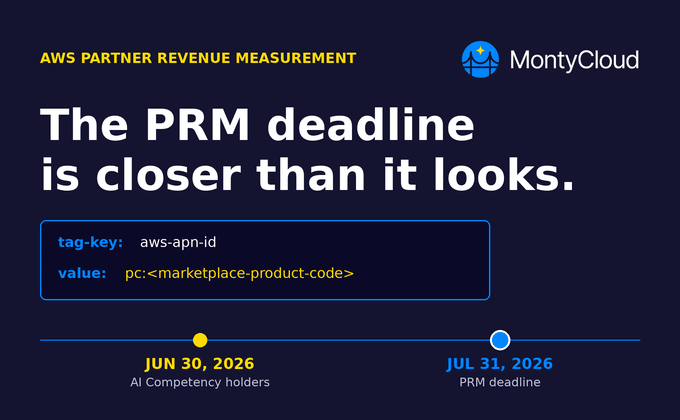
The AWS Partner Revenue Measurement (PRM) operational deadline is July 31, 2026 for the broader AWS partner ecosystem. Partners holding the AWS AI Competency are being asked to have at least one AI service tagged under PRM by May 31, 2026. PRM works by reading the tag aws-apn-id with a value of pc:<marketplace-product-code> on customer resources, and attributing the associated spend to the partner the product code belongs to.
Have you noticed PRM keeps coming up on partner calls?
Have you noticed that PRM keeps coming up on partner calls, and that nobody seems entirely sure what the actual deadline is? You’re not alone. The operational date most of the AWS partner ecosystem is converging on is July 31, 2026, and if you hold the AWS AI Competency, you’re working to an earlier one than that. Here’s what’s real, what’s ecosystem consensus, and what to do this week.
Meet Sara: A partner-ops lead working the PRM problem
Sara is the kind of partner-ops lead I talk to almost every week. She works at an AWS Premier Partner, and her CSM mentioned in a routine call that her firm’s revenue attribution under Partner Revenue Measurement is going to look different next year. The ecosystem is treating July 31, 2026 as the cutoff. Then, almost as an aside, he adds that because her firm holds the AI Competency, they’re being asked to have at least one AI service tagged a month earlier, by May 31.
Sara opens the AWS documentation, reads three pages, and her coffee is now cold. This isn’t a tagging project. It’s a chain of dependencies, with a tagging project sitting at the end of it. Her first instinct is to assign an engineer for a week. Somewhere around hour four she pictures herself in May, writing tense emails to that same engineer about why attribution is still broken, and changes her mind.
What is AWS Partner Revenue Measurement (PRM)?
AWS Partner Revenue Measurement (PRM) is the attribution mechanism AWS uses to credit partner-influenced customer spend. When I’m explaining PRM to partners, I tend to start with the mechanism rather than the program, because the mechanism is what tells you whether you’re on track.
AWS reads a specific tag on customer resources, aws-apn-id with a value of pc:<marketplace-product-code>, and attributes the associated spend to the partner that product code belongs to. Spend without the tag doesn’t count, regardless of how real the engagement was. Everything else about PRM, the policy framing, the tier implications, the funding consequences, sits on top of that one mechanical fact.
What PRM attribution impacts
The attribution flows into:
- Partner tier qualification
- Co-sell visibility with AWS field sellers
- MDF (Marketing Development Funds) and SDF (Sales Development Funds) eligibility
- AWS Marketplace and ACE (APN Customer Engagements) motion priority
- “Deployed on AWS” visibility signals
A lot of downstream impact riding on a tag.
The three PRM attribution methods
| Method | Best for | Effort level |
|---|---|---|
| Marketplace Metering | Supported AMI and ML listings | Lowest, automatic where it applies |
| Resource Tagging | Most partner workloads | Moderate, carries most operational load |
| User-Agent Decoration | API-driven architectures | Higher, more engineering involvement |
Most partners end up doing some mix of metering and tagging.
When is the AWS PRM deadline?
July 31, 2026 (ecosystem operational deadline)
AWS’s official PRM documentation is relatively neutral about consequences and explicit dates. The July 31, 2026 cutoff is the date the AWS partner ecosystem (consultancies, advisors, partner-program guidance) has converged on as the operational deadline. The consequences most often cited are:
- Reduced co-sell visibility
- Lower field-seller prioritization
- MDF and SDF funding impact
- ACE motion friction
Those are partner-channel guidance, not formal contractual policy. So when I talk to partners about this, I tell them what’s actually happening underneath: AWS is shifting from estimated influence to measured attribution. Partners who aren’t measured will be progressively less visible in the AWS sales motion. That’s enough to act on.
May 31, 2026 (AWS AI Competency holders)
One earlier date matters specifically for AI Competency holders. Partners holding the AWS AI Competency are being asked to have at least one AI service tagged under PRM by May 31, 2026. This guidance is circulating through Partner Central and PDM (Partner Development Manager) channels rather than appearing in public AWS documentation, so confirm specifics with your PDM.
PRM prerequisites: what has to be true before you can start tagging
This is the part Sara hit at hour four. PRM has prerequisites, and if your firm hasn’t completed them, tagging isn’t your immediate problem.
- Partner Central 3.0 migration. PRM onboarding depends on the linked Partner Central account. If your migration isn’t complete, that’s your blocker.
- AWS Marketplace listing. PRM requires a Marketplace product code for tagging to work. A public listing is preferred or required depending on your product type.
- Marketplace product code retrieval. This is the value side of the tag,
pc:<marketplace-product-code>. You can’t apply the tag until you have the code. - Account linkage. Your AWS account needs to be linked to Partner Central correctly so attribution flows where it should.
Only after all four can tagging begin.
Why ongoing PRM coverage matters as much as initial tagging
PRM attribution is not a milestone. It’s a continuous state, and that’s the part most partners are underestimating right now.
Tagging fails the same way at every customer I’ve worked with. A team does a great first pass. Solid IaC modules, tags in place, everything looking right. Then a developer rebuilds something from a slightly older module that doesn’t carry the tag block, and the tag doesn’t come back. Nobody notices, because nothing visibly breaks. The resource keeps running. The customer keeps paying. The only thing that’s gone is the partner’s attribution claim on that spend.
PRM hasn’t started producing attribution reports yet, so partners haven’t felt this version of the failure mode directly. They will. The mechanics that make tags fall off existing tagging programs are the same mechanics that will make PRM tags fall off PRM-tagged resources. The difference is that with PRM, the silent failure costs you co-sell visibility and funding eligibility instead of just a column in a cost report.
This is where partners are most exposed right now, because AI and ML services are growing the fastest and where tagging discipline is weakest. For AI Competency holders, those drift gaps become a compliance problem before they become an attribution problem. At dozens or hundreds of customer accounts, manual tagging just doesn’t hold up.
How MontyCloud helps with AWS PRM tagging
MontyCloud supports PRM today across a broad set of AWS services. For AI specifically, that includes:
- Amazon Bedrock
- Amazon Bedrock AgentCore
- Amazon SageMaker
- Amazon Comprehend
- Amazon Connect
Which is what matters for AI Competency holders working to the May 31 deadline.
Operationally, this is what the platform does:
- Continuous discovery of resources that should carry PRM tags but don’t, across every customer account under management
- Automatic tag application at provisioning and as part of ongoing remediation
- Drift detection, so the Bedrock workload that lost its tag in a rebuild doesn’t quietly become an attribution gap
- Coverage reporting that tells you which customer accounts are at risk of being undercounted before the cycle closes
The whole point of leveraging a platform like this is that your engineers aren’t spending their time on tag coverage, they’re doing whatever it is that makes you money. For partners working to either deadline, that’s how the prerequisite chain and the implementation happen in parallel instead of stacked.
What AWS partners should do this week
Start with the prerequisite chain, because nothing else matters until it’s clear.
- Confirm your Partner Central 3.0 migration status. If it isn’t done, that’s your critical path.
- Confirm your AWS Marketplace listing status. If there’s no listing or no product code, that workstream needs to start immediately, because listing readiness is often the longest pole.
- Inventory your managed customer accounts. How many, which services, where the AI/ML footprint is growing.
- If you hold the AI Competency: confirm the May 31 expectation with your PDM and decide which AI service you’re tagging first.
- Assign ongoing coverage ownership. Not just initial tagging. Drift, new accounts, new resources. If the answer is “we’ll figure it out,” that’s the answer that fails in October.
Conclusion
PRM is not technically complicated. It’s operationally demanding, dependency-heavy, and easy to underestimate. The partners who get ahead will be the ones who treat tag coverage as continuous operations rather than a one-time setup, and who get the prerequisite chain moving now, while there’s still time to absorb the inevitable slips before the first attribution cycles begin.Start with the Partner Central and Marketplace status checks this week, even if you do nothing else. You’ll learn more from those two answers than from another week of reading. In a follow-up post, I’ll walk through how to apply PRM tags through Terraform without setting off drift detection on every plan. It’s a small operational detail that derails more rollouts than it should.
Frequently asked questions (FAQs on PRM)
What is the AWS PRM deadline?
The AWS partner ecosystem is converging on July 31, 2026 as the operational deadline for Partner Revenue Measurement. AWS AI Competency holders are being asked to tag at least one AI service by May 31, 2026.
What tag does AWS PRM use?
PRM uses the tag key aws-apn-id with a value of pc:<marketplace-product-code>. AWS reads this tag on customer resources and attributes the associated spend to the partner the product code belongs to.
What happens if a partner misses the PRM deadline?
Partner-channel guidance cites reduced co-sell visibility, lower AWS field-seller prioritization, MDF and SDF funding impact, and ACE motion friction. AWS is shifting from estimated influence to measured attribution, so unmeasured partners become progressively less visible in the AWS sales motion.
What are the three PRM attribution methods?
Marketplace Metering (automatic for supported AMI and ML listings), Resource Tagging (most common, used for most services), and User-Agent Decoration (for API-driven architectures).
Which AI services does MontyCloud support for PRM tagging?
Amazon Bedrock, Amazon Bedrock AgentCore, Amazon SageMaker, Amazon Comprehend, and Amazon Connect.
What prerequisites are required before PRM tagging can begin?
Partner Central 3.0 migration, AWS Marketplace listing, Marketplace product code retrieval, and correct account linkage to Partner Central.
About the author
Tony Bulding is a Principal Sales Engineer at MontyCloud. He works with AWS Partners and MSPs on cloud operations automation, and helps partner teams scale governance and tagging without scaling headcount.